THE ECONOMY
A successful transition
En route to Economic and Monetary Union
Stable growth of gross domestic product
An interesting trading partner
Domestic demand as an incentive for development
Lower unemployment than in the European Union
A budget aimed at progress
Gross domestic product per capita in 2000: 9,105 USD
Growth in gross domestic product in 2000: 4.6%
Inflation in 2000: 8.9%
Exports in 2000: 10.7 billion USD
Imports in 2000: 11.3 billion USD
Balance of trade in 2000: 94.7%
Unemployment in 2000: 7% (surveyed unemployment level according to ILO standards)
Source: Statistical Office of the RS, Chamber of Commerce and Industry
 A successful transition
A diverse industrial history, a tradition of openness to the world and a well-managed state economic policy all contribute to the fact that Slovenia is among the most successful countries in transition from a socialist to a market economy.
Slovenia has a stable growth of gross domestic product and, according to Dun & Bradstreet's analysis of risk levels in countries in transition, Slovenia has the lowest level of risk. In March 2000, a report by experts from the World Bank and the International Monetary Fund positively rated Slovenia's economy, stressing that because of its successful fiscal reforms it has already reached the level of the developed West European states.
En route to Economic and Monetary Union
In the area of fiscal policy, Slovenia's strategic goal is a broadly balanced budget, which should be made easier by the introduction of value added tax in 1999, pension and social security system reforms and the gradual reduction of state subsidies to the level specified by the European Union.
With regard to incomes policy, Slovenia has in the last few years slowed down wage increases, which are now below the increase in labour productivity.
Active employment policy measures have lowered the unemployment rate, so that it is now comparable to that of the EU member states.
Slovenia maintains a global trade orientation and is strengthening its economic ties with CEFTA member states and the former Yugoslav republics in particular, in addition to its strategically most important partners - the EU member states.
Stable growth of gross domestic product
According to the Statistics Office of the Republic of Slovenia, in 1995 GDP was 9,431 USD per capita, three years later it was 9,847 USD, and in 2000 it was 9,105 USD per capita. According to estimates by the Institute for Macroeconomic Analysis and Development from March 2000, the GDP per capita in 2000 should reach 9,767 USD. This means that Slovenia has already brought its GDP very close to that of some EU member states, such as Greece and Portugal.
 |
|
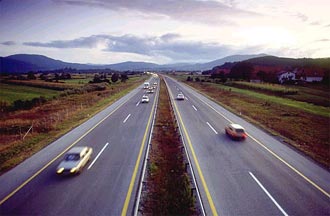
Slovenia's programme of motorway construction and other road building is to be completed by 2004 |
According to the Agency for Payments, Slovene businesses ended 2000 with a net profit of 117,5 billion SIT, which was two billion less then in 1999.
An interesting trading partner
Slovenia's trade is mainly with EU states, particularly Germany, Italy, Austria and France. However, its economic relations are widening and alongside an increase in trade with its existing partners, it aims to include new markets within the EU, to re-establish trade links with parts of the former Yugoslav market and to achieve a greater presence in the USA, in some states of the former Soviet Union and among CEFTA members.
In 2000, according to data supplied by the Statistical Office, Slovenia exported 8.8 billion and imported 9.9 billion USD worth of goods. At the end of 2000, according to the Bank of Slovenia, direct foreign investments amounted to nearly 3 billion USD (2,907.3 million USD). Most came from Austria, France, Germany, Italy, the Czech Republic, Great Britain, the USA and the Netherlands.
Domestic demand as an incentive for development
According to the IMAD's report, in 2000 economic growth was stimulated by domestic demand which was 12,4% higher than in 1999.
Lower unemployment than in the European Union
In May 2000, according to the Slovene Statistical Office, out of a population of two million, the labour force amounted to 959,000 people, including the registered unemployed. In 2000, a Statistical Office survey using ILO criteria showed unemployment at 7 %. Slovenia has prepared a labour market strategy for long-term development until 2006, and the unemployment problem is also addressed by the National Employment Action Programme for 2000 and 2001. The average gross monthly salary in Slovenia in 2000 was 191,669 SIT (approximately 800 USD).
A budget aimed at progress
Government revenue for 2001, specified in the Budget adopted by the National Assembly in April, will amount to 1160.7 billion SIT, whilst expenditure will be 1210.4 billion SIT. The budget deficit will thus reach 50.4 billion SIT, which equals one percent of GDP.