THE COUNTRY AND ITS PEOPLE
The land and its location
Population
Minorities in Slovenia, Slovenes across the border
The language
Freedom of belief
Population
Area: 20,273 km2
Length of borders: 1,334 km;
with Austria: 330 km; with Italy: 232 km; with Hungary: 102 km;
with Croatia: 670 km
Length of coastline: 46.6 km
Population: 1,965,986 (1991 census)
Population density: 97 inhabitants per km2
Nationalities: (1991 census):
Slovene 1,727,018; Italian 3,064;
Hungarian 8,503; other: 227,401
Language: Slovene; in nationally mixed areas also Italian and Hungarian
Source: Statistical Office of the Republic of Slovenia
 The land and its location
Slovenia covers 20,273 square kilometres stretching between the Alps, the Adriatic and the Pannonian Plain. In spite of its geographically small size, it is a convergence point of a range of different landscapes: Alpine and Mediterranean, Pannonian and Dinaric, each of which has its own characteristics and unique features.
At the heart of Europe, between Austria to the north, Italy to the west, Hungary to the east and Croatia to the south, Slovenia has always been a crossroads of trans-European routes.
Population
Slovenia has a population of 1,965,986, of which 87.9 per cent are Slovenes. The official language is Slovene.
The capital, Ljubljana, is the largest city as well as the political, administrative, economic, educational and cultural centre of Slovenia.
Ljubljana's history goes back several thousand years. The city also boasts a rich medieval heritage, as well as numerous Renaissance, Baroque and Secessionist buildings.
The works of the architect Jože Plečnik, who gave the city a new image in the modernist, neo-classical and Secessionist style, are particularly well known.
 |
|
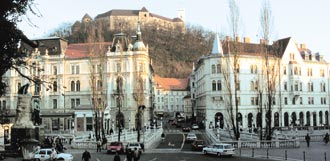
The Three Bridges in Ljubljana, with the castle in the background. The Three Bridges were designed by the architect Jože Plečnik between 1929 and 1931, and were built between 1931 and 1932. |
Minorities in Slovenia, Slovenes across the border
From the first settlements in the 6th century onwards, Slovenes have constantly struggled for territory, fighting Germanic, Romanic, Hungarian and other Slavonic nations in the process.
They lost a lot of their original territory along the way - hence the Slovene minorities in Italy, Austria and Hungary. Conversely, there are Italian and Hungarian national minorities in Slovenia.
The Republic of Slovenia guarantees the minorities their fundamental and special rights. In the ethnically mixed areas, bilingualism is guaranteed.
The language
Slovene is a South Slavonic language, spoken by only two million people. In spite of various, in particular Germanic influences, it has preserved its special features. The most notable of them is the dual form, nowadays very rare in other languages. The oldest known written record in Slovene, the Brižinski spomeniki (The Freising Manuscripts) date from the beginning of the 10th century and the first Slovene book dates from 1550.
Freedom of belief
According to public surveys, most Slovenes are Catholic (around 70 per cent). There are around 30 other religious communities, spiritual groups, societies and associations registered in Slovenia. Among the oldest is the Evangelical Church, most widely spread in the eastern part of Slovenia.
Population
Slovenia's population is slowly declining with the lowest birth-rate both in Europe and the world. But the infant mortality rate is among the lowest in Europe and the world (4.8 per 1000 live-born). Life expectancy for men is 70.79 years and 78.25 for women. There is nearly 100% literacy in Slovenia (99.6%).