SPORT
History of Sport
The national programme
Winning disciplines
Achievements worthy of national pride
Number of national leagues: 69
Number of sports societies and clubs: 3,000
Number of members of sports societies and clubs: 400,000
Number of top level and competition class sportsmen and women: 88,000
Budgetary funds earmarked for sport (2000): 0.27% of GDP
Source: Ministry of Education, Science and Sport
 History of Sport
The first Slovene encyclopaedia writings (Slava Vojvodine Kranjske, 1689) describe boating, cave exploration, fishing, hunting, mountain climbing, shooting and ski-ing. The 17th century description of a skier from Bloke is the oldest written record of ski-ing in Central Europe. In spite of this documented early existence of sport, the first Slovene sports association The Southern Falcon) was founded in 1862, as a response to the German Turnverein.
In 1905 the Slovene Falcon League appeared, uniting 115 societies. Around this time numerous other societies were formed: mountaineers, cyclists and students joined, the latter organising their Slovene sports societies at universities.
Between the First and the Second World Wars the first professional sports leagues were formed and after the Second World War, the Physical Culture Association was set up, which later became the Sports Association of Slovenia, with the later addition of an association for physical education called Partizan.
In 1991, the Slovene Olympic Committee was founded, which was recognised a year later by the International Olympic Committee. Slovene competitors took part under the Slovene flag for the first time at the Olympic Games in Albertville in 1992.
The national programme
The state is creating suitable conditions for the development of sport via the National Sports Programme, which was adopted by the parliament and which determines short-term, mid-term and long-term goals. The programme determines that sports activities are in the public interest and it covers the overall organisation of physical education, recreation, high-quality sports, top-level sports and sports activities for the disabled.
The Ministry of Education, Science and Sport financially supports sports activities in all areas.
Winning disciplines
Slovene sportsmen and women are very successful at international level. So far, they have won 50 Olympic medals, and more than 360 world championship medals. The best results are gained in ski-ing, athletics, ski-jumping, gymnastics, rowing and white-water canoeing and in team sports like basketball, volleyball, handball and, more recently, in European Cup football.
 |
|
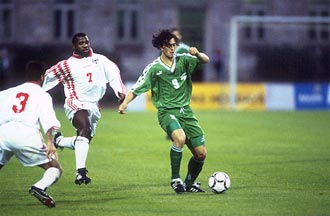
Qualifying for the European Championship 2000 is a historic achievement for the Slovene football team. |
A special place in Slovene sport is occupied by Alpinists. Their achievements are not a coincidence. Mountaineering and Alpinism have a very long tradition in Slovenia, and mountaineering is also one of the most popular forms of recreation. The latest mountaineering feats have reverberated around the world. In mid-November 1999 Tomaž Humar completed a solo ascent of the south face of Daulaghiri, described as a challenge for the third millennium. And on 7 October 2000 Davo Karničar became the first person to ski non-stop down from the 8,848-metre summit of Mount Everest, the world's highest mountain.
Achievements worthy of national pride
The first great achievements in the history of world sports accomplished by Slovene sportsmen and women were mainly in gymnastics, as Slovene gymnasts were before the Second World War among the best in the world. Particularly famous was Leon Štukelj who, between 1922 and 1936, won eight gold, four silver and five bronze medals in three Olympic Games and three world championships.
After the Second World War, the reputation of Slovene gymnastics was carried forward by Miro Cerar, with two gold medals and one bronze medal at the Olympic Games in Tokyo and Cuidad de Mexico. In the last twenty years it is skiers who have achieved the best results and have stood on the winning podiums at major competitions (world cups, world championships and the Olympic Games). Slovene ski jumpers are also very successful.
 |
|
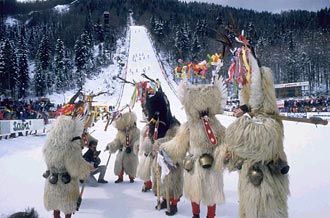
In 2000, at the Planica giant ski-jump, the Austrian Andreas Goldberger jumped 225 metres, breaking the ski-jump world record. |
In the eighties and nineties, Slovene scullers won medals at world championships and Olympic Games. The 1996 Olympic Games in Atlanta were also very successful for Slovene sportsmen and women. They won two silver medals. Even more successful were they in Sydney where they won two golden medals, in rowing and shooting.
Among the winners of Olympic Games medals in team sports are also Slovene basketball, handball and football players, who won their medals as members of Yugoslav teams.
Slovenia is considered to be an excellent organiser of world competitions. The Vitranc Cup in Kranjska gora and the Zlata lisica Cup on the Pohorje are included in the World Cup ski-ing programme. The annual final competition of the ski-jumping World Cup takes place at Planica, on the largest natural ski-jump in the world. In addition, there are also the annual International Gymnastics Tournament in Ljubljana, the Šiki Memorial in athletics and other competitions at European and world levels.