SOCIAL SECURITY AND HEALTH CARE
Legislation on health insurance, social security and pension insurance
Compulsory health protection
Voluntary health system
Stable financing of health care
Pension system reform
Preventing social exclusion
Indicators per 10,000 population (1999)
Number of doctors and dentists 32
Number of nurses 64
Number of hospital beds 59
Indicators total (2000)
Number of residents of old people's homes 11,779
Number of residents of special care institutions 1,629
Number of inmates in work units for the disabled 2,057
Number of claimants of social security
- as the sole source of income 1,178
- as an income supplement 32,777
Average number of monthly claimants: total (2000)
Old age pension 284,776
Invalidity pension 98,503
Widow's pension 663
Family pension 88,504
Farmer's pension 9,744
State pension 50
Source: Statistical Office of the RS, Ministry of Labour, Family and Social Affairs
 Legislation on health insurance, social security and pension insurance
As a Central European state, Slovenia has a tradition of compulsory health insurance stretching back more than 110 years. The Republic of Slovenia as an independent state adopted its own legislation in the field of health and social care and pension and disability insurance in 1992.
The Health Care and Health Insurance Act was adopted in 1992 and later supplemented. The Pension and Disability Insurance Act was first adopted in 1992 and in 1999 a new law came into force, which introduced pension reform and a new, 'three-pillar' pension system and disability insurance.
 |
|
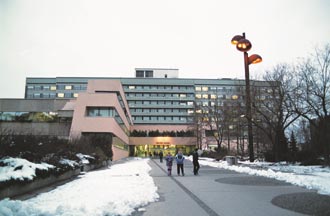
In Slovenia, there are 26 hospitals and maternity hospitals with 11,233 beds. The most important Slovene health institution is the Central Teaching Hospital in Ljubljana. |
Compulsory health protection
Health insurance is compulsory for everybody with a permanent address in Slovenia. This insurance, paid by the insured, employers and other contributors guarantees access to health services, medicines, technical aids, as well as sickness and other financial benefits. The compulsory health insurance covers most health risks, but not all and not fully. The difference has to be paid by those insured out of their own pockets, or they can pay for additional insurance.
For managing health insurance is responsible the Health Insurance Institute.
Voluntary health system
In 1999, a new Mutual Health Insurance organisation was established to manage voluntary health insurance, taking in all the 1.1 million people with voluntary insurance policies at the Institute of Health Insurance of Slovenia. A special feature of this insurance organisation is that it is owned by its members, those insured, and it functions according to the principles of mutuality and non-profitability.
Stable financing of health care
The Health Insurance Institute has for a number of years financed programmes of compulsory health insurance with approximately the same share of public funds: around 7 per cent of GDP, which is approximately 650 USD per capita. In 2000, the share of GDP spent on health was 7.9 per cent, of which 6.8 per cent was public expenditure.
Health expenditure per capita according to purchasing power was 1,100 USD, of which public expenditure was 950 USD. Slovene health capacities are comparable with those in the European Union. At the end of 1999, Slovenia had 25 doctors, 7 dentists, 64 nurses and 59 hospital beds per 10,000 population.
In addition to the public network of health institutions in Slovenia, private healthcare is also developing. Its share of the total health care services is around 10 per cent.
Pension system reform
Following the new Pension and Disability Insurance Act, in force since January 2000, the pension system is similar to that in the rest of Europe. Thus the new retirement age for men is 63 and for women 61. The new system, which has been agreed by all the social partners and which is being introduced gradually, increases the long-term financial stability of the pension system and with it, the social security of all Slovene citizens.
Preventing social exclusion
The state ensures the functioning of social care institutes, creates the conditions for private social work activities, and stimulates and supports the development of self-help, charity work, programmes enabling a more independent life for the disabled, and voluntary work in the area of social security.
The state ensures that social exclusion is prevented, particularly by influencing the social position of the population in the areas of taxation, employment and work, and through grants, housing policy, family policy, health care, education and other policy areas. The state also pays special attention to the disabled, and those with mental or physical disabilities.