GEOGRAPHIC REGIONS
Regions
The Alps
The Mediterranean coast and hinterland
Dinaric range
Pannonian Plain
National and landscape parks
Environmental protection
Geographical division of Slovenia:
Alps
- 42.1% of territory
Dinaric Alps
- 28.1% of territory
Pannonian Plain
- 21.2% of territory
Mediterranean
- 8.6% of territory
Climate:
continental in central Slovenia
Alpine in the north-west
sub-Mediterranean along the coast and its hinterland
Average temperature:
January: -2°C
July: +21°C
Average annual precipitation: from less than 800 mm in the east to more than 3,000 mm in the north-west
Highest peak:
Mount Triglav - 2,864 metres
Largest protected natural area:
Triglav National Park, 83,807 ha
Largest karst cave:
Postojna Cave
19.5 km
Largest lake:
Cerknica Lake (intermittent)
26 km2
Longest river: Sava - 221 km
Highest waterfall: čedca, 130 metres
Source: Statistical Office of the RS
 Regions
The territory of Slovenia is geographically divided into four basic types of landscape - Alpine in the north, Mediterranean in the south-west, Dinaric in the south and Pannonian in the east.
In everyday use, regional names are more common than geographical ones: Gorenjska (Upper Carniola), štajerska (Styria), Prekmurje (the Mura river region), Koroška (Carinthia), Notranjska (Inner Carniola), Dolenjska (Lower Carniola), Bela krajina (White Carniola) and Primorska (the coast and its hinterland. Gorenjska is mainly Alpine and Primorska Mediterranean, but štajerska reaches into the Pannonian Plain, and Notranjska into both the Dinaric and Mediterranean types of landscape. Because of its geographical diversity, there are different types of climate in Slovenia: continental, Alpine and Mediterranean.
The Alps
The largest part of Slovenia's territory is taken up by the Alps. This area is divided into three mountain ranges. In the north-west, there are the dolomitic limestone Julian Alps including the highest peaks in Slovenia - Triglav (2,864 m), the Karavanken Alps (the highest peak here is Stol (2,236 m) and the Kamnik-Savinja Alps, Grintavec (2,559 m) being the highest peak here.
 |
|
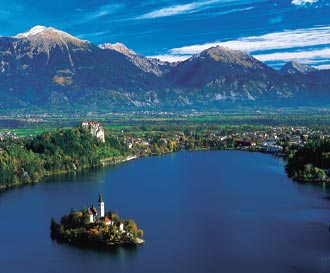
Bled is world famous for its glacial lake, its island and castle. |
 |
|
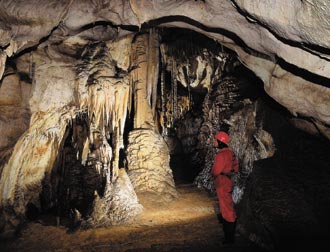
The Postojna Cave is one of the most beutiful and most visited caves in the world. |
 |
|
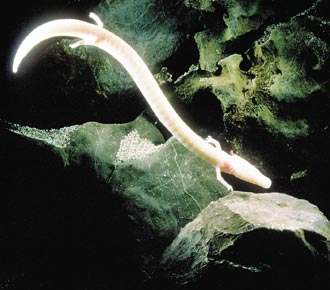
Proteus anguinus (in Slovene, the 'human fish') - a tailed amphibian, which breathes with both lungs and gills - is an endemic species of the Dinaric karst, protected since 1922. |
Slovenia is the 3rd most forested country in Europe, with 54% of its area covered by woods and forests.
The Mediterranean coast and hinterland
The Slovene coast is the part of the Mediterranean where the Adriatic reaches deepest into Central Europe. In the Mediterranean part of Slovenia, lower-lying limestone karstic plateaux and karst plains alternate with Flysch landscapes. In the karst land water dissolves the porous limestone, seeping below the ground. The surface is therefore full of karst sinkholes and swallow holes, whilst beneath the surface there are numerous caves and chasms.
The Karst is also called the 'original Karst' as it was here that research into karst phenomena first started, also giving the name to the branch of science studying them - 'karstology'. A third of the area is forested (white oak and black hornbeam). Particular natural features of the coast are the Strunjan cliff, the highest Flysch cliff on the Adriatic, as well as the Sečovlje salt-pans, the only wetlands protected under UNESCO's Ramsar Convention (1993).
Dinaric range
The tall Dinaric plateaux give way to a Mediterranean landscape, whilst in the east they turn into a low, karstified plateau (Suha krajina), karst plains (Bela Krajina) and hilly areas. Among the plateaux, where there are hardly any surface waters, there is a string of karst poljes with disappearing rivers. A special feature of karst poljes are intermittent lakes. The largest among them is Lake Cerknica (26 square kilometres. The cool and damp Dinaric area is the most forested part of the country. One of the most famous representatives of the wild life of the Dinaric area is the amphibious inhabitant of the karst caves - the Proteus.
Pannonian Plain
The Pannonian Plain in the east and the north-east of the country is the most fertile farmland in Slovenia. The Mura, the Drava, the Sava and their tributaries deposited gravel on large plains.The climate of the Pannonian Plain is typically continental. A special natural treasure of this part of Slovenia are the thermal and mineral waters. In the hilly parts there are vineyards.
National and landscape parks
Approximately 8% of the Slovene countryside is protected by legislation. A programme of further protection has already been approved by the parliment and gradually almost a third of the country will be covered. This is not surprising considering that Slovenia can boast of 7,000 registered karst caves, 15,000 animal species and 3,200 plant species (some of them endemic).
The largest protected area in the country is the Triglav National Park. In addition, there are another 37 protected landscape parks, 1 regional park, 623 natural heritage sites and 49 nature reserves.
The most attractive among them are the Logarska Valley, Rakov škocjan, the Sečovlje salt-pans, Strunjan, Lipica and Snežnik Castle.
The 49 protected nature reserves in Slovenia also include areas of primeval forest, mainly around Kočevje. There are also interesting geological features in Slovenia, among them the Idrija break, where there is a mercury mine.
Environmental protection
In the second half of the nineteen-eighties, Slovenia was the first of all the East and Central European countries to set up an environmental fund. In 1999, the National Assembly adopted the National Environment Protection Programme (NEPP), which is intended to provide support, during the process of joining the European Union, for the protection of biotic diversity and the institutionalised strengthening of the administration.