EDUCATION
Introducing nine years of primary education
Educational profile
Primary education
Secondary education
Higher education
Number of primary schools (2000/2001) 814
Number of pupils in primary schools (2000/2001) 182,725
Number of pupils per teacher (2000/2001) 12
Number of secondary schools (2000/2001) 146
Number of pupils at secondary schools (2000/2001) 104,501
Number of further and higher education establishments (2000/2001) 69
Number of students at both universities (2000/2001) 64,989
Number of further and higher education graduates (2000) 10,472
Number of students enrolled for postgraduate study (2000/2001) 2,991
Source: Ministry of Education, Science and Sport, Statistical Office of the RS
 Introducing nine years of primary education
The Slovene school system has seen a number of changes in recent years, aiming to ensure that as many people as possible realise their right to education better than they have done before, thus achieving a higher educational level. The reform of the curriculum from pre-school to secondary school education, which took three years, is now complete. At 42 of the 446 independent primary schools they have started to implement a new programme of primary education lasting nine years.
The education system in Slovenia is almost fully financed from the state budget. Public expenditure for education includes expenditure on primary, secondary and tertiary institutions, as well as the running costs of pre-school education, post-graduate study and expenditure related to boarding at some secondary schools and university students' accommodation. Included are both state schools and private schools with concessions.
Educational profile
The educational profile of Slovenia's population is improving. In the 25 to 64 age group, the average number of years spent in education is 9.6. The best educated are those employed in the area of education and public administration. In comparison with other countries with a medium or high level of development, in 1992 Slovenia came behind Austria, Switzerland, Belgium, Denmark, Israel and Hungary with regard to years spent in education. 98 per cent of primary school leavers decide to continue their education, and 84 per cent of secondary school leavers go on to university. The number of graduates is increasing too: in the '1999 generation' for the first time ever exceeded 10,000.
Life-long learning is also increasing. Adults attend open universities, educational and study centres, schools and higher education establishments, as well as courses organised by companies, administrative bodies, organisations and societies.
Primary education
In the academic year 2000/2001, there were 814 primary schools in Slovenia with 182,725 pupils, and more than 16,000 teachers, giving a ratio of one teacher per 12 pupils.
In the same school year, 42 primary schools started introducing nine-year programmes. This system will gradually (by 2003/04) replace the current eight-year programme. The nine-year programme, for which no pre-school education is compulsory, is divided into three periods of three years, and children are six years old when they first enrol.
Secondary education
After completing primary school, nearly all children (98 per cent) go on to secondary education, either vocational schools, technical schools or gimnazije (grammar schools).
Grammar schools carry out more general secondary education leading to external matriculation examinations; they prepare children for higher education.
Children of foreign residents are also appropriately provided for in Slovenia and can receive an education at all levels.
Higher education
Slovenia has two universities: the University of Ljubljana and the University of Maribor. The University of Ljubljana was founded in 1919 and encompasses 27 faculties, academies and other schools of higher education. The University of Maribor, which was founded in 1975, consists of 9 faculties and one school of higher education.
 |
|
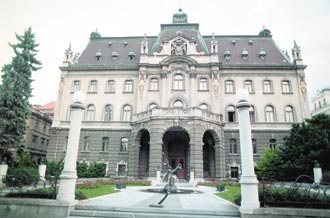
The University of Ljubljana has, since its beginnings in 1919, had its main seat at the former provincial mansion, built in 1902. |
In the academic year 2000/2001, there were 43,683 students enrolled at the University of Ljubljana and 17,333 students at the University of Maribor. In the academic year 2000/2001, at the two universities 2,991 students were enrolled for post-graduate study.