ECONOMIC SECTORS
Original tradition
Private enterprises
Retail
Quality standards
Construction
Energy
Agriculture
Tourism
Stock exchange
Transport and communications
Number of all businesses in Slovenia in 1998: - 145,602
Sectors according to added value:
manufacturing (car, chemical and pharmaceuticals) - 23.8%
real estate - 10.5%
retail, wholesale - 10.0%
transport, storage and communications - 7.0%
public administration, compulsory social insurance - 5.0%
construction - 5.3%
education - 4.9%
health and social security - 4.7%
financial services - 3.7%
other - 25.1%
Source: Statistical Office of the RS
 Original tradition
Slovenia saw many changes in its economic system in the last century. Today's independent Republic of Slovenia, is directed towards development and a market economy.
In the past Slovenia, in spite of its mainly agricultural nature, always maintained contacts with the world and new developments. The first steam train came to Ljubljana in 1849; in 1890 the capital installed mains water. The first radio greeted Slovenes in 1928. Before the Second World War, the most important economic sectors were the metal and machinery, textile and clothing, and wood-processing industries. In the decades after the War the greatest contribution to domestic product was the manufacture of motor vehicles, which also employed the largest number of people.
Private enterprises
Nowadays, the largest number of Slovene businesses are connected to retail and wholesale trade, followed by real estate, manufacture, leasing, business services, construction and transport, storage and communications. Private enterprises and enterprises with domestic capital prevail.
Retail
According to the Statistical Office, in 1999 there were 9,357 retail enterprises and 6,959 wholesale enterprises and other organisations, which together employed 97,741 people. In 1999, retail and wholesale enterprises sold 3,656 billion SIT worth of goods. There were approximately 17,199 shops in Slovenia that year, which is one per 116 people. There are also some foreign retail companies on the Slovene market; and more are to come.
Quality standards
Successful Slovene enterprises have adapted to an export orientation, in particular by improving quality and by taking steps to enable them to function in accordance with European standards.
According to the Chamber of Commerce, by the end of April 2001, 890 Slovene enterprises had obtained an ISO 9000 certificate of quality.
Construction
Construction is one of the stronger economic sectors in Slovenia mainly on account of road building. Housing construction has also revived.
Energy
In 1999 Slovenia produced 13,261 gigawatt hours (GWh) of electricity. The total consumption of electricity in Slovenia in 1999 amounted to 10,432 GWh, which is less than was produced, so Slovenia was able to export 1,934 GWh of electricity that year.
Agriculture
In 1999 there were 343 farm enterprises, companies and co-operatives in Slovenia, employing 7.855 people, among which there were 1,363 qualified professionals.
The major agricultural products are wheat, corn and barley. There is also a high yield of corn for ensilage, sugar beet, potatoes and lucerne, as well as apples and pears. In 1999, Slovenia had 1,111,661 hectares of forests with an annual accretion of 6,248 cubic metres.
Tourism
According to the Statistical Office, the foreign currency inflow from tourism in 2000 amounted to 959,000,000 USD. In 2000, 1,957,116 domestic and foreign tourists visited Slovenia (the share of foreign visitors was 56%), making 6,718,998 overnight stays (the foreign share here was 45.3%). On the basis of the number of overnight stays there are four main markets: Germany, Italy, Austria and Croatia, these are followed by Great Britain, the Netherlands and Russia.
Stock exchange
Among the businesses in Slovenia in 2000 there were, according to the Statistical Office, in addition to the central Bank of Slovenia, 31 banks, 108 savings banks and other financial organisations, 45 investment companies and 12 insurance companies. At the end of 2000, 267 share certificates from 225 issuers (companies, the state and municipalities) were placed on the Ljubljana Stock Exchange..
Transport and communications
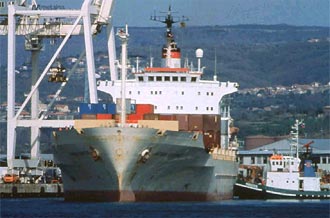
In 1999 259,720,000 passengers and 104,585,000 tons of cargo were carried in Slovenia. Slovene railways carried 13,907,000 passengers and 14,396,000 tons of cargo. In the same year, Slovene sea ports handled 8,412,000 tons of domestic and international cargo. 2,199 ships entered Slovene waters.
 |
|
Koper is an important port for Austria, southern Germany and the Central European states. |