CULTURE
Culture - a basis for Slovene identity
Budgetary funds for culture
A nation of writers and readers
Theatre, ballet and opera
Film
Music
Visual art
Architecture
Amateur theatres, music and dancing
Events of international significance
Financial resources earmarked for culture (2000) 0.90% GDP
Number of titles published (1999) 3,976
Number of general public libraries (1999) 60
Library stock excluding school libraries (1999) 15.9 million
Number of books borrowed (1999) 16.7 million
Number of professional theatres (2001) 10
Number of people who attended performances in professional theatres (1999/2000 season) 681,000
Number of professional orchestras (2001) 5
Number of museums (1999) 60
Number of permanent galleries (1999) 45
Source: Statistical Office of the RS
 Culture - a basis for Slovene identity
In the year 2000, Slovenia celebrated two important anniversaries: 450 years since Primož Trubar published the first Slovene book, and 200 years since the birth of France Prešeren, the most important Slovene poet. The former anniversary is linked to the foundations of the Slovene literary language and the latter to a time of Slovene national and cultural revival, and with the appearance of one of our most important national political programmes. The arts and culture have a special place in the history of the Slovene nation. With them Slovenes, as did other Central European nations, substituted to a large extent for the non-existence of their own state and political institutions, and it is through their language and culture that for centuries Slovenes managed to preserve their identity as a nation.
Budgetary funds for culture
In spite of the polycentric organisation of Slovene cultural activities, it is the state which is mainly responsible for culture. It finances professional institutions in the field of music, theatre, the protection of the cultural heritage, the national library, most international cultural co-operation projects, a large proportion of publishing, and the cultural activities of the Hungarian and Italian national minorities and of Slovenes abroad.
A nation of writers and readers
Less than two decades ago, Slovenia was the European record holder for the number of published new titles per capita. People obtain books mainly from libraries: around 15 million books are borrowed annually.
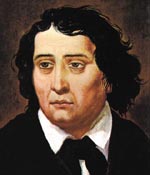
Two writers are considered as the founders of Slovene culture and literature: the first is the reformer Primož Trubar (1508-1586), who in the mid-sixteenth century commissioned the printing of the first two Slovene books Catechism and Abecedary, and the second the poet France Prešeren (1800-1849). This renowned artist of the European Romantic movement proved with his writing that the Slovene language was equal to the other European languages, whilst through his poetry he also started the first significant national programme. A part of his poem Zdravljica (A Toast) is now used as the national anthem.
 |
|
The highest Slovene awards for cultural achievements, awarded on the Slovene Day of Culture, 8 February, are named after France Prešeren. |
Theatre, ballet and opera
In addition to two opera and ballet houses and two puppet theatres, there are nine other theatre establishments in Slovenia. More than 500,000 people attend theatre performances in Slovenia each year 28 December 1789 is known as the 'birthday' of Slovene theatre, when the dramatist, poet, historian and one of the most important Slovene national figures Anton Tomaž Linhart (1756-1795), prepared the first performance in the Slovene language of his comedy Županova Micka. In 1867, a Dramatics Society was founded in Ljubljana. Contemporary theatre artists (directors, actors, set designers) have created achievements which have been noticed abroad and have for a number of years been regular guests at the most prestigious theatre festivals in Germany, Italy, France and South America.
 |
|
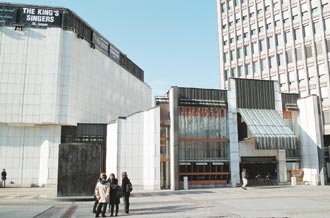
Cankarjev dom in Ljubljana is the largest cultural and conference centre in Slovenia. Many international performances and festivals take place here. |
Film
Approximately 140 Slovene feature films have been made so far, plus a few hundred documentaries and short films. The Film Fund of the Republic of Slovenia, founded in 1994, is responsible for allocating subsidies. Between 1995 and 2000, the fund subsidised the production of 30 feature films, 56 short film projects.
The young generation of film directors (Igor Šterk, Janez Burger, Vito Taufer) have made films which have received very favourable reactions from juries at international film festivals.
Music
In addition to two opera houses and a number of top instrumental and vocal performers in Slovenia, there are also five professional orchestras, the performances of which were, in the 1998/99 season, attended by 198,000 music lovers. Among the most important performers of classical music are the Slovene Philharmonic Orchestra and the Slovene Radio and Television (RTV) Symphony Orchestra. More popular genres have, since the end of the Second World War, been performed by the large RTV Dance Orchestra. Among vocal groups, the professional choir of RTV, the Slovene Octet and the Carmina Slovenia choir are known outside Slovenia's borders.
A special musical phenomenon are the world famous founders of traditional popular music The Avseniks. But internationally, the strongest response is achieved by contemporary Slovene composers. After the First World War, Marij Kogoj and Slavko Osterc joined the modern European musical current. Later Marjan Kozina, Primož Ramovš, Uroš Rojko, Jani Golob, Vinko Globokar and Aldo Kumar presented Slovene music to a wider European public. Among musical performers, the pianist Dubravka Tomšič, the flute player Irena Grafenauer and the mezzo-soprano Marjana Lipovšek, all of whom perform mainly abroad, have received the highest acclaim.
Visual art
There are 45 permanent galleries and more than 800 occasional exhibition areas in Slovenia. The most important are the Modern Gallery in Ljubljana, with 7,600 works of art and a permanent art collection from the 20th century, and the National Gallery, with its collection of older Slovene art as well as some works by earlier European painters.
Architecture
Architecture has a special value in Slovenia's cultural heritage and the most famous Slovene architect is Jože Plečnik (1872-1957). Among the achievements of his neo-classical style are the renovation of Hradčani Castle in Prague, the Zacherl House project in Vienna, and a number of interesting churches in Slovenia and elsewhere. Ljubljana can boast of his town-planning renovations.
Amateur theatres, music and dancing
More than 100,000 people used to take part in amateur cultural activities in Slovenia, mainly young people. Nowadays, there are approximately 1,700 cultural groups, mainly choral, musical, theatre and puppet-theatre groups. The widespread amateur culture facilitates a lively cultural life even in the smallest Slovene towns and villages.
Events of international significance
The numerous cultural performances, such as the International Graphical Biennial, the annual Ljubljana Summer Festival, the Lent Festival in Maribor, Exodos the festival of dance arts in Ljubljana, the Borštnikovo srečanje theatre festival in Maribor, the PEN gathering in Bled and the gathering of writers in Vilenica also have a very good reputation. In May and June 1997, Ljubljana hosted the European Month of Culture and in 2000 (June to September) the European biennial of contemporary arts Manifesta 3.